Home » Posts filed under Android
Showing posts with label Android. Show all posts
Currently, Apple does not officially support third party keyboards to replace the default keyboard on iOS, but developers can get around this limitation by building an alternative keyboard into their app. Today, Fleksy made it easy for developers to built the Fleksy keyboard into their app. The Fleksy keyboard is now available for any iOS developer who wants to include it in their app. This announcement is very exciting because if developers get on board it will give iOS users the choice of which keyboard to use.
Having Fleksy integrated in apps is also a positive for blind and visually users. Fleksy works well with VoiceOver and because Fleksy is so good at predicting which word you are trying to type being able to see the keyboard is not as important. The Fleksy keyboard is much quicker and easier to type on then the default iOS keyboard especially for VoiceOver users.
Unlike Android were you can download Fleksy and use it will all of you favorite apps, each iOS developer will have to build in support for the keyboard. Hopefully, now that Fleksy is available for all iOS developer Fleksy will become ubiquitous on iOS. If you would like to see Fleksy integrated into one of your favorite apps you could contact the developer and ask for Fleksy integration.
To try out Fleksy download the app for iOS or Android. Fleksy is currently available in select apps such as Launch Center Pro. Click read more below to view images and videos of Fleksy.
New in iOS 7 and Android KitKat: Customize Subtitles and Captioning
Both iOS 7 and Android KitKat include the ability to customize captions. Now both major mobile operating systems include the ability to customize movie and video subtitles system wide.. For iOS, the customization settings are under Settings > General > Accessibility > Subtitles & Captioning. From that menu you are able to change the appearance of subtitles of any video played through the default iOS video player. There are many options for customization including font, font size, font color, and background color. Android includes a similar feature that can also be accessed in the settings menu. These options are a welcome addition to mobile devices and can make subtitles much easier to see. It is great to see both Apple and Google improving accessibility on their mobile products.
Amazon Improves Accessibility Features of Kindle Fire Tablets
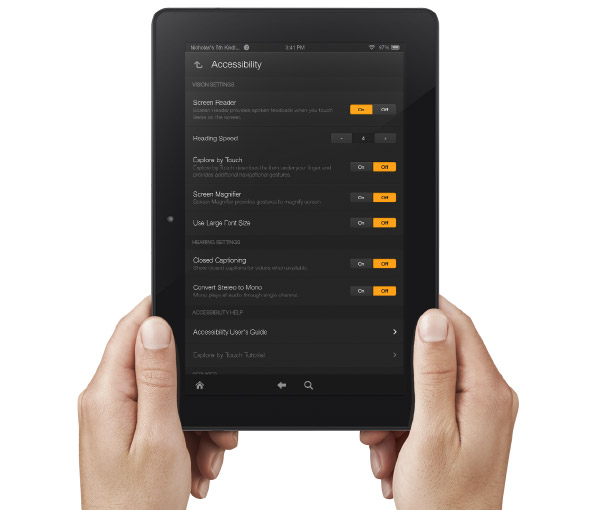
Amazon's newly announced Kindle Fire HD and Kindle Fire HDX include built in accessibility features. Historically, Amazon has been slow to make their Kindle products accessible. With the new accessible Kindle Fire and accessible Kindle app for iOS Amazon maybe turning a new page. That being said, Amazon still doesn't want to make their Kindle eReaders accessible and has requested an exemption from the FCC.
The new Android based Kindle Fire tablets includes accessibility features for the blind, low vision, hearing impaired, and mobility impairments. For the blind and visually impaired the Kindle Fire includes a screen reader that can describe what is taking place on screen. There is also Explore by Touch which allows users to use gestures to navigate items one-by-one. For low vision users the new Kindle Fire tablets include a screen magnifier which is activated by a triple tap on the screen. There are also large font size and high contrast options to benefit low vision users. For users with mobility challenges the Kindle Fire can be controlled with a Bluetooth keyboard. For dyslexic users the Kindle Fire includes Immersion Reading which synchronizes the text and audio version of a book. With Immersion Reading the text is highlighted as a professional reader speaks. It is important to note that to use Immersion Reading you must own both the Audible audio version and the Kindle ebook version which can be costly. While it is very exciting to see Amazon improving their accessibility features other tablets such as the iPad include more robust accessibility features.
The Kindle Fires also include a "Mayday" button that allows you to connect with technical support at anytime. The support person can then help walk you through using different functions of your tablet. This "Mayday" button could be useful especially for new tablet users.
The Kindle Fire is available in 7 and 8.9 inch form factors both sizes are available in HD or more powerful HDX variety. The cost ranges from $139 to $229 depending on the size and features. Click here to purchase from Amazon. Click read more below to view a video about Immersion Reading.
Reveiw: Celluon Epic Laser Keyboard
The Celluon Epic is a Bluetooth laser keyboard. The compact device projects a QWERTY keyboard onto most flat surfaces. (Glass tabletops being the exception) You can connect the Epic to vertically any device that supports Bluetooth keyboards including devices running iOS, Android, Windows Phone, and Blackberry 10. On the back of the device there is a charging port and pairing button. Once you have the Epic paired with your device it acts the same as any other keyboard.
For any keyboard the most important consideration is the typing experience that it provides. The virtual keyboard brightness is adjustable and is easy to see in most lighting conditions. Unfortunately the brightness does not automatically adjust based on ambient light. With each keystroke a beeping sound is played which can be turned down. The typing experience on the Epic is mediocre at best. Inadvertently activating the wrong key can make typing frustrating and tiring. Even if you are a touch typist you'll still need to look down on the laser keyboard as you type. The Epic is definitely not for the blind or visually impaired.
Compared to a conventional keyboard the Epic doesn't hold its own, but if you look as the Epic as a supplement to your on screen keyboard the Epic looks more promising. If you have trouble typing on your smartphone or tablet the compact Epic may be perfect for you. You can easily bring the Epic along in your pocket and then use it when you need to type a longer email or text.
The Epic is available directly from Celluon for $169.99 and through Amazon for a special price of $149.99. Click read more to view more photos of the Celluon Epic.
Google's Advance Voice Search Comes to Chrome
Recently Google added advanced voice search to the Chrome browser. Google's advance voice search feature was previously only available for Android and iOS, but is now available on Mac and Windows. The feature is similar to Apple's Siri ,but works on your computer as well as mobile devices. To access the feature, navigate to Google using the Chrome browser and press the microphone icon to the right of the search bar. Then you can search by voice and Google will speak back select results. I have found the voice recognition to be very fast and accurate. One of the most notable features for struggling spellers is that you can ask how to spell a word and then Google will speak back the correct spelling. Google will also provide spoken responses for many other queries as well. Watch the above video to learn more.
Google Now Possibly Coming to iOS
Google's popular Google Now feature may be coming to Apple devices if a leaked video is to be believed. Google Now is currently an Android exclusive feature but Google has brought flagship Android features to Apple devices in the past. One example is Google's advanced voice search that came to iOS last year. Google Now has predictive cards that provide information to users automatically. The cards gather information about a users search history and provide useful information automatically. Engadget.com was sent the video which was later taken off YouTube. The leaked video is visually similar to other Google promotional videos with lends credence to its authenticity. If the video is legitimate Google Now would be a great addition to Apple's mobile devices.
Click read more to view another video about Google Now.
CamNote is Launched for iOS & Android Smartphones
About two weeks ago, I was reading some blog posts on my Flipboard app when I came across a piece about a new app called CamNote for IOS and Android platforms which was just recently released. The blog was accompanied with a great video tour of the app which caught my attention. CamNote lets you have the best of both worlds-continue to hand write your notes on the CamNote A5 Journal or A7 Jotter as you have always done and then scan them in with your smartphone using the free CamNote app. The developer has done a fantastic job of developing an app that quickly and automatically recognizes the borders of the writing pads so that you can upload your notes to DropBox, Evernote, or Google Drive in one quick step. If you have ever tried to scan a document with your camera you will realize the benefits of using the CamNote system to archive and share your notes with others. The CamNote A5 Journal or A7 Jotter are well designed and the quality of the paper is fantastic and developed so that ink will not bleed through the page. Once you upload and tag your notes to Google Drive or Evernote you can take advantage of their OCR feature to search and find words in your uploaded notes. Organizing your hand written notes has never been so easy with the CamNote System. If you are interested in purchasing CamNote in the United States email me for the details. If you still enjoy using pen and paper to take your notes but want to take it to the next level, then you need to take a look at CamNote. The CamNote system is an ideal way to capture, archive and share your hand written notes with others- so give it a try!Google Play Books Adds Read Aloud Feature
Google Play Books is the Google's ebookstore and companion reader apps. The Android reader app was recently updated to include a text-to-speech read aloud feature. Click here to download the free app for Android. The text-to-speech voice is a little above average but gets the job done. The read aloud feature works with most books in the Google Play store. If you have an Android device be sure to check this app out.
Click read more below to view screenshots of Google Play Books.
Smart eBook Interface Makes Navigation a Breeze
A new concept eBook reader app improves navigation of eBooks on tablets. The app makes eBook navigation more like the navigation of a printed book. This concept is best for sighted users and may not work as well for the blind and people with physical disabilities. The concept app allows the user to flip through multiple pages quickly, find pages more quickly and more. Currently this is only a concept but may soon be coming to the App Store. While iBooks has an easy to use interface, this new concept seems to take it a step further. Click here to learn more about Smart E-Book Interface. Click "read more below" to see more images of the app in action.
Wolfram Alpha is a Knowledge Engine
Wolfram Alpha is an internet based Knowledge Engine. It does more than a search engine because it can do complex math and science equation, generate bar codes, graph equations, display nutritional information and much more. You can try Wolfram Alpha free by clicking here. Wolfram Alpha gives you direct answers instead of links like Bing and Google. Wolfram Alpha can even answer trivia questions like the distance to mars or the width of a football field. The results of the search are displayed in a clear and organized manner that is easy to read.
Wolfram Alpha also has dozens mobile apps for iOS and Android. To learn more about the apps click here. The Wolfram Alpha app is a mobile portal into the Wolfram Alpha knowledge base. Other apps made by Wolfram Alpha include course assistance apps to help you pass your classes and specialized reference apps.
Siri, the iPhone 4S assistant feature also uses Wolfram Alpha to answer your question. To learn more about Siri click here.
Click read more below watch a video about Wolfram Alpha.
Merriam-Webster Voice Activated Dictionary
Using a dictionary can be very difficult if you do not know how to spell the word you are looking for. The free Merriam-Webster app for iOS and Android solves this problem. The app allows the users to speak their search into their device just with their voice. The speech recognition is very accurate and speedy. Voice activation allows users to search for word that they can not spell. In addition to voice search, the app includes a pronunciation button which allows you to hear the correct pronunciation of a word. The app uses Nuance's speech recognition engine for voice activation. To download the free Android app click here. To download the free iPhone, iPod Touch and iPad app click here.
To learn more about other apps with Nuance speech recognition click here. To learn about accessibility features in iOS 5 click here and here.
Android Voice Search
Android phones are becoming more and more popular. Android phones do not have built-in accessibility features like the iPhone, iPad and iPod Touch. iOS devices have many built-in accessibility features but Android phones do not. One feature that Android phones do include is voice input. With voice input you can touch the microphone next to the space bar and speak your text. A similar feature is a available with Google Chrome (click here). Voice input is a helpful feature for people who struggle to spell or have physical disabilities that makes typing difficult. You can access voice input wherever there is a keyboard on Android by pressing the microphone button next to the space bar. iOS does not have system wide voice input but it is rumored to be coming in the upcoming iOS 5 this fall. If you have an iPhone, iPad or iPod Touch you can use the Dragon Go! app to get similar features.
OCR apps for iPhone and Android (update)
Update: Zoom reader is an other OCR app for iPhone that deserves consideration.
Google Announces Voice Search for Desktop
Yesterday, Google announced voice search for desktop. The same feature has been available on Android for a long time. Within the next week a microphone button will appear on the right side of the search bar. To activate voice search click on the microphone and speak your query. The feature will only work with Google Chrome at launch. This feature will be great for people that have trouble spelling. If you do not know how to spell a word that you want to search you can say the word and the correctly spelled word will be inserted. Voice search will also benefit people that have trouble using a keyboard. The voice search feature is not available yet but will be shortly. Google may integrate this feature into its other web services such as Gmail.
Technology Predictions for 2010

I guess this is the time of the season to look into the crystal ball and make predictions about the year ahead. Certainly 2009 has been an exciting year for all types of technology and in 2010, I predict we will begin to see even more rapid developments. One of the really exciting development has been in the area of mobile handsets.
With more people connected to the web via their smartphones we need to take a look at this factor and plan accordingly. With Apple raising the bar with the iPhone we have seen a flurry of development and new smartphones are being released on a weekly basis. This year we saw the release of the BlackBerry Storm 2 as well as the Motorola Droid featuring the Android operating system from Google. This has certainly been a hotbed of development and the apps for these mobile devices continues at a furious pace. Next year we will continue to see huge developments in the mobile handset market which will play out well for us in education. The real tipping point for this technology will be the ability to run Flash applications on these handsets. From what I have been reading Adobe is working hard with Research in Motion (BlackBerry) and Google to build Flash into their development tools. Once Flash becomes standard on these devices you will see incredible applications that can deliver on the promise of these devices for learning. In many cases the students we work with are carrying very powerful computing devices which could be used as an educational tool to advance their learning. So next year look for smartphones to play a larger role in the area of classroom and mobile learning. I am already beginning to see a number of companies that are developing accessories or companion products to work with smartphones which could really propel this whole arena. So next year might just be the year of mLearning- that is mobile learning opportunities from anywhere on your smartphones.
As much all of us are used to starting up our applications from our hard drives - we will continue to see a shift to the cloud at even a faster pace of adoption. I recently had a conversation with my nephew who is in his early twenty's who had just purchased a new Windows laptop. I asked him if he had purchased a copy of Microsoft Office to install and he looked at me and said "there is no reason to, I am now using GoogleDocs for all of my work." So yes there is a huge shift happening and as we move forward we will begin to see more and more students and educators adopt the cloud to do all of their work. I suspect that as I speak to educators, that many schools will jump on board in 2010 and will sign up for Google Apps for Education. In doing so, both teachers and students will recognize the quantum leap in collaboration and learning that just wasn't possible with standalone applications. So look for 2010 to bring about huge shifts in collaboration and moving to the cloud for our personal computing.
We have also just begun to witness the movement from the printed book to the digital book and 2010 is going to be a banner year for ebooks as it explodes into the market. If it is any indication, Amazon reported that their sales from downloaded books to the Kindle outpaced that for printed books for the 2009 Holidays! With this in mind we will see a number of new players in this market with their own spin on the feature set. During the 2009 holiday season we saw the release of the Nook from Barnes & Noble which was an instant success. We also have Sony in the market touting not one but three different Sony Readers. Competition is good, and I suspect we will see a host of other companies making announcements about their branded eReaders at the Consumer Electronic Show come this January in Las Vegas. In any case- it is clear that ebooks will evolve over time and will play a much bigger role in schools. As we saw in the Kindle 2- having access to text to speech built-in can make a world of difference for students who need accessible curriculum material. Having consumer products that are designed with assistive technology from the beginning helps to keep the costs down and make it a universally designed product from the get go.
I hope you have a wonderful and Happy New Year! I would appreciate hearing about your predictions for 2010- so feel free to add your comments.
Interesting Uses of QR Codes for Educators
Many of us are used to seeing those familiar UPC Codes on products that can be scanned at the check out counters to look up the price and product name. While attending the DevLearn 09 Conference I came across another type of bar code called the QR Code. While I had seen them in different venues I did not at first grasp how they might be used during a conference or in an educational setting. At the DevLearn 09, QR Codes could be found on the signage of every workshop that when read by a QR Reader on a smartphone would take you to a web site for additional information about the presentation. While QR Codes have been popular in Japan, they are just beginning to gain popularity in the United States and Europe. I obtained this information from Wikipedia about QR Codes which I though would be of interest to you:
With the rise in the number of smartphones (Android, iPhones, Blackberry) in use, QR Codes become a great way for "tagging" physical information that links to a URL. With a QR Reader installed you can simply point your camera phone at the QR Code and be instantly taken to a website to provide your viewers with additional information. You can embed text, RSS feeds, and URL's in a QR Code. Imagine printing the code on lectures, notes or study guides so that your students can be supplied with supplemental information. Or how about adding QR codes to physical objects in your environment and have your students learn more about the topic. The use of QR codes are endless! So give it a try and let me know what you think. So download a QR Reader to your smartphone and give this QR Code a try! To generate and print out a QR code go to the Kaywa website. So point your smartphone camera at the QR Code below to see what happens!

A QR Code is a matrix code (or two-dimensional bar code) created by Japanese corporation Denso-Wave in 1994. The "QR" is derived from "Quick Response", as the creator intended the code to allow its contents to be decoded at high speed.
QR Codes are common in Japan, where they are currently the most popular type of two dimensional codes. Moreover, most current Japanese mobile phones can read this code with their camera.
With the rise in the number of smartphones (Android, iPhones, Blackberry) in use, QR Codes become a great way for "tagging" physical information that links to a URL. With a QR Reader installed you can simply point your camera phone at the QR Code and be instantly taken to a website to provide your viewers with additional information. You can embed text, RSS feeds, and URL's in a QR Code. Imagine printing the code on lectures, notes or study guides so that your students can be supplied with supplemental information. Or how about adding QR codes to physical objects in your environment and have your students learn more about the topic. The use of QR codes are endless! So give it a try and let me know what you think. So download a QR Reader to your smartphone and give this QR Code a try! To generate and print out a QR code go to the Kaywa website. So point your smartphone camera at the QR Code below to see what happens!
One Sentence Summary Created with Context Organizer With a QR Reader installed you can simply point your camera phone at the QR Code and be instantly taken to a website to provide your viewers with additional information.
Google Announces Android
We are living in very exciting times especially with regards to technology and the power that can be harnessed into very small devices. Just this past week, Google announced that they were releasing on Open Source Software Developer Kit called Android that would become new application platform for cell phones. They also announced that they were going to have a pool of $10 million dollars available to reward companies and individuals that designed innovative solutions with Android. To get a sense of the potential of Android- take a look at this YouTube video.