Showing posts with label science. Show all posts

LabQuest 2 from Vernier- Connected Science System

It has been a couple of years since I last reviewed the Labquest from Vernier, so when I was able to get my hands on the LabQuest 2, I was really excited to find out about all the new enhancements in this new handheld connected science system. The LabQuest 2 is about the size of large cell phone with a high contrast screen that is powered by a high capacity rechargeable Lithium battery. The Labquest 2 has a great design and feels very solid in your hands as you use the device. The high resolution touch screen is great for viewing when you are using it outside in the field. Vernier did not skimp on the processing power in this device and you will find it very responsive when you are collecting or analyzing data on the device. The LabQuest 2 supports all of the Vernier sensors making it easy for schools who have invested in their devices and probes. The LabQuest 2 now includes both WiFi and Bluetooth which opens up all kinds of possibilities which I will discuss later in the post. Additionally, the LabQuest 2 has built-in accelerometers as well as GPS which can be utilized with other sensors for recording such data. I should mention that the LabQuest 2 is compatible with both Mac and Windows computers.


LabQuest 2 Screenshot
But no matter how good the hardware is-how does the LabQuest 2 hold up when in use? This is where this device really shines! Teachers will find that the LabQuest 2 is a dream to use-just plug in the sensor which will be automatically detected by the LabQuest 2 and press the Collect button to get started. Instantly students will be able to see their data being displayed on the screen. Once the data is collected students can spend their time using the analytic tools built in or transfer the data to a computer. Teachers can also have students email the data, graph, or screenshot directly from the LabQuest 2, that was captured, which makes it easy to include in a lab report. The LabQuest 2 supports analysis with linear and curve fits and allows students to record their notes on the device, with the on-screen keyboard. Teachers will enjoy the fact- knowing that the LabQuest 2 comes with over 100 experiments that are pre-loaded on the device which students can access. If teachers would like to customize the labs, Vernier has a handy Lab Creator Tool that is available to teachers that allows you to tweak the lab to your liking. 


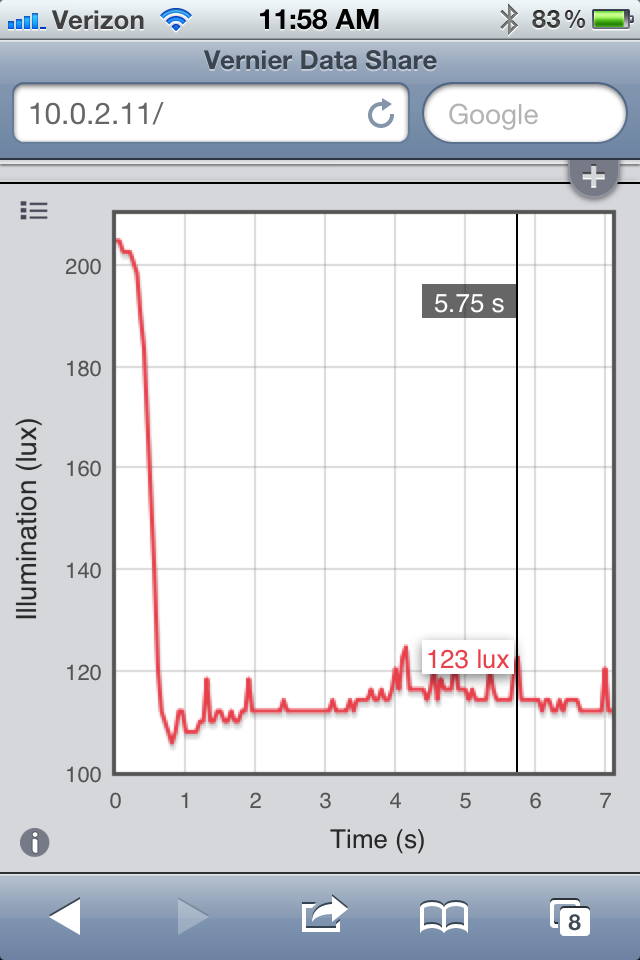
Vernier Data Share on iPhone 4S
In this age of bring your own device (BYOD) Vernier has taken this model to heart and created the "connected science system," allowing anyone with a browser to view and interact with the collected data. This enables students with iPhones, Android Phones, iPod Touches, and iPads, to launch their browser and view the data live as it is being collected. All the students need to to do is go to their Settings and make sure that their device and the LabQuest 2 is on the same wireless network. Now simply launch the browser and enter in the IP address or name of Network and voila you are ready to view the data being collected in real time. I have tested various browsers, using my iPhone, iPad, and Kindle Fire with the LabQuest 2 and in each case the data was instantaneously available for me to preview in real time. For a richer set of tools, teachers can purchase the Graphical Analysis for iPad app from the App Store.

With the LabQuest 2, Vernier has transformed the way teachers need to think about teaching science in the classroom and provided them with an easy and powerful solution for capturing data in real time. Utilizing their "connected science system" with the LabQuest 2 it is now possible to extend their set of tools to students, so that they can collaborate in real time-by simply launching a browser. For teachers that want to create more interactive science lessons and give students the opportunity to collect data the LabQuest 2 is certainly an outstanding tool you should include in your classroom. Giving students the opportunity to both visualize and analyze data is at the heart of science and what better way to make it hands-on than with the LabQuest 2. For ore information about the LabQuest 2 you can click here.

If you are considering using the LabQuest 2 in your classroom Vernier will be offering free 4 hour workshop sessions in the Fall. For more information about the workshops click here.

SPARKvue for the iPad from Pasco


With the start of the semester I have been busy preparing for my classes but still have some reviews in the hopper that I have been meaning to post for some time. This past summer I had a chance to speak with Wayne Grant, Ph.D., Chief Education Officer at Pasco, a leading science education company located in California about the release of SPARvue for the iPad. Pasco has been known for their high quality science probes and software for some time now and are leading proponents of mobile solutions to help make science education come alive in the classroom. Dr. Grant was kind enough to show me the latest release of SPARKvue a software app that runs on the iPad that can teamed up with various probes so that students can collect data in real time.
Using the PASSPORT Airlink 2 students can collect real time data on the Ipad without the need to be directly connected. The PASSPORT Airlink 2 uses Bluetooth technology to automatically send data from the sensors to the iPad for instant visual analysis. I had a chance to work with the PASSPORT Airlink 2 and one of Pasco's Weather sensors to see what it would be like to use, to collect data. Pairing the Bluetooth PASSPORT Airlink 2 with the iPad was a cinch and within seconds after plugging in the Weather probe I was collecting data about the humidity in New Jersey. Based on my experience I would say that the PASSPORT Airlink 2 has good range and I was able to collect data from at least 20to 25 feet away from my iPad. It was really exciting to be able to see the data streaming live to my iPad using the PASSPORT Airlink 2 and the Weather probe. Pasco should be commended for designing such and elegant solution that can be used with the iPad to give students hands on opportunity to collect data in real time. Pasco once again has shown their ingenuity and innovation in the design and implementation of this device. If you would like to try out the SPARKvue app just go to the Apple Apps Store and download to see how it works.

Vernier Releases LabQuest Mini

I have always been a big fan of the use of probeware in the classroom and firmly believe that when teachers use these digital tools, that students gain a deeper understanding of the scientific concepts and principles they are studying. Probeware helps students to visualize scientific phenomena which would otherwise be difficult to explain. Having a visual representation of the data is crucial for students and gives them another avenue for understanding the information at hand. Over the years I have used a number of different devices from Vernier and I am glad to share with you that they recently released the LabQuest Mini. The LabQuest Mini is a small lightweight device the plugs directly into the computer that accepts both digital and analog probes. The LabQuest Mini has 5 sensor ports which is accept a range of probes. The LabQuest Mini is powered by the USB port and does not require any batteries or adaptes which makes it the perfect companion for today's netbooks. The LabQuest Mini is compatible with over 50 Vernier probes and ships with Logger Lite to get your students up and running to collect, analyze, and chart data. The LabQuest Mini can also be used with Logger Pro for those times when you need more advanced tool set.

Setting up the LabQuest Mini was a breeze. I simply updated my version of Logger Pro from the internet and plugged in the LabQuest Mini into the USB port on my laptop and within seconds I was collecting temperature and grip strength. The set up could not have been easier with the LabQuest Mini and it size and functionality are certainly going to be two factors that will make schools very pleased with this offering from Vernier. The LabQuest Mini has a price of $149 dollars and is an ideal tool in the science classroom especially for those schools that are using netbooks in their classrooms. All in all, the LabQuest Mini from Vernier brings exceptional functionality and value, which should make it a staple in every school science program.

Vernier LabQuest Emulator

Over the year's I have written about the importance of giving students hands-on experience when doing science and what better way to do it than with probeware. Vernier, one of the leaders in this area has developed the LabQuest an easy to use handheld device that can be used in the classroom or in the field to collect data using an array of different probes and sensors. Using the LabQuest students can collect and analyze their data in ways that were once too time consuming to actually do in the classroom. Using the LabQuest students can collect the data in real time and spend the rest of the time analyzing and making sense of the data that was collected. The LabQuest does all of the heavy lifting and allows the students to better visualize the meaning of the data.

I recently had the opportunity to test out the LabQuest Emulator which currently works on the Windows platform and allows teachers to display a working LabQuest on their computer which is ideal for demonstrations and for teaching. You can download a free copy of the LabQuest Emulator from the Vernier website. Once you have downloaded the LabQuest Emulator you will need to have your LabQuest connected to your computer via the USB port and your probe connected to the LabQuest. Within a minute or so you will see your LabQuest on your computer screen with a live digital read out. In my case, I plugged a temperature probe into my LabQuest and was able to see the temperature read out on my computer screen. The LabQuest Emulator software is an ideal way for teachers to demonstrate how to use the LabQuest and is a great tool that can be used with an interactive whiteboards. I have created a short screencast showing you the LabQuest Emulator in action. I hope you enjoy it. You can also download a free copy of Inclusion Times which talks about the importance of using tools like the LabQuest with students to help them analyze and visualize data more effectively.

Vernier's Labquest Handheld Data Analysis Tool

I have written great deal about the use of probeware in the classroom and how it can change the way science is taught in schools. At NECC 2007, Vernier Software & Technology was showing their latest product called LabQuest. LabQuest is a handheld data capture tool with real time graphing and analysis that is done with the device's high resolution touch screen. The LabQuest looks to be the perfect device for both in the classroom and for field use. Students can plug in any on of the 50 sensors to collect data. Read the Press Release below for more information
-------------

Vernier’s New ‘LabQuest’ Handheld is the Most Versatile
Data Analysis Tool in Science Education Today

Device serves as one-stop source for data collection and analysis

Beaverton, OR – June 25, 2007 – A new, intuitive handheld device places data analysis at the fingertips of science students and educators, whether they are in the lab or in the field. With LabQuest from Vernier Software & Technology, students can plug in Vernier sensors to acquire real-time graphing and analysis via the device’s color screen for subjects such as physics, chemistry, biology and Earth science.

Vernier LabQuest allows students to collect data from more than 50 sensors and view and analyze the data in a meter, data table or graph. The device also enables students to draw a prediction before taking data, display a tangent line on their graphs, as well as use linear and curve fits, autoscales, integral functions and statistics in their analysis.

The handheld contains six sensor ports, a built-in temperature sensor for measuring ambient temperatures, and a built-in microphone for recording voice.. Other built-in applications include a stopwatch, a periodic table, an on-screen keyboard and a scientific calculator. The 40 MB storage capacity can be expanded through an SD/MMC card or USB drive.

Users can operate the LabQuest using the built-in LabQuest Graphing and Analysis Application or connect it to either a PC or Mac in order to export collected data to Vernier’s Logger Pro software. The handheld can also be connected to a printer, headphones, speakers or other devices.
(more)
LabQuest Brings Versatile Data Analysis to Science Studies
Page 2

The 320 x 240 color graphic display with LED backlighting provides sharp, clear color images. LabQuest is designed for ease of use, allowing for navigation through either its buttons or by pressing an accompanying stylus to the touch screen and on-screen keyboard. In addition, the rubber overmolding and rugged design provide protection against bumps, falls and water. A lithium-ion rechargeable battery pack ensures that users can use the device for an entire school day before having to recharge.

“Our new LabQuest is a breakthrough in data-collection technology. For the first time, students have complete capabilities while out in the field,” said David Vernier, co-founder of Vernier and former physics teacher. “The LabQuest allows for professional-grade inquiry while out in the field and fosters scientific analysis for all students. And we have backed it with a comprehensive curriculum.” Vernier has embedded more than 50 science labs in LabQuest, and 10 of the company’s popular lab books have been updated with instructions for using the handheld in experiments.

Pricing and Availability
LabQuest is scheduled to ship in September 2007 for a price of $329. Purchases of eight or more devices will earn a discount price of $299 each. Vernier will demonstrate the device to the media during NECC.

Educators can visit www.vernier.com/labquest to view an online product tour and up-to-date details, sign up for a free 30-day preview, and see when free Vernier workshops offering LabQuest demonstrations and hands-on trials will be in their area.

About Vernier Software & Technology
Vernier Software & Technology has been an innovator of data-collection technology for 25 years. Creating easy-to-use and affordable science interfaces, sensors, and software, their products can be found in education from elementary school to college. Vernier helps teachers enhance their science curriculum, increase learning, and build students’ critical thinking skills. Vernier’s technologies are in use worldwide in more than 120 countries. For more information visit www.vernier.com.
# # #

Review of InspireData

Take a look at a new and very interesting application called InspireData from the Inpsiration Company that was released this summer. For the full review go to LD Resources

Enjoy

Brian